
How to Check Criminal History in Angels Camp
Choose the office by the kind of event. Angels Camp Police creates city incident and arrest reports. Calaveras County Jail creates the booking entry. The Superior Court records charges, hearings, pleas, and disposition. California DOJ provides a fingerprint-based review of a person's own statewide summary record rather than a public name search for someone else.
- Ask Angels Camp Police for a city police report through its named request process.
- Supply the report number when known, plus the incident date, location, and involved parties.
- Check Citizen RIMS, daily booking logs, VINE, or the jail for recent custody facts.
- Search the Calaveras Superior Court Tyler portal for a filed case and calendar events.
- Use California DOJ Live Scan only to review your own statewide summary history.
The broader Calaveras County criminal history overview explains county and state channels in more depth. Angels Camp requests should stay with the city first when city officers created the report.
Angels Camp in a One-City County
Angels Camp is Calaveras County's only incorporated city. Its 2020 Census population was 3,667, and it sits on the Highway 49 corridor in California Gold Country. That municipal status gives Angels Camp a police records counter that unincorporated communities do not have. Yet the courthouse, jail, prosecutor, probation department, and public defender remain centered in San Andreas.
This geography creates a clear split. A local incident begins with Angels Camp Police. A booking, prosecution, or court outcome belongs to a county office. State custody and a personal DOJ record review sit farther up the chain. Treating each layer as a separate source prevents a police report from being mistaken for a final court result.
The Angels Camp Police Department
The Angels Camp Police Department directs readers to its records request and police-report materials. The department counter is at 200 Monte Verda Street, Angels Camp, CA 95222. A requester should use the Police Report Request Form and provide enough facts to locate the event. A report number is best; an incident date, location, contact details, and involved names can help when that number is unknown.
Police reports follow department policy and California disclosure law. Fees are collected when applicable upon release, but the research does not establish a fixed city report fee, so a requester should wait for the department's response. Parking citations may also be handled at this address, but those citations are not criminal-history records. Keeping that distinction clear avoids sending a criminal-record question through a parking payment route.
Angels Camp's Ten-Day Records Timeline
The city records instructions say to allow up to 10 working days for a response. That is a response window, not a promise that every report will be released in full. California law permits withholding or redaction for privacy, active investigations, juvenile confidentiality, victim safety, and other protected material. The requester may receive a release, a partial release, a fee notice, or an explanation of a limit.
Use the named Police Report Request Form, allow the stated time, and do not assume that a pending prosecution will follow the ordinary public-copy path. Fees are collected when applicable upon release, but the city source does not publish a fixed amount.
Note: A complete request with the report number and incident details gives Angels Camp staff the clearest way to locate the file.
Arrests and Bookings in Angels Camp
Angels Camp Police can make the arrest and write the city report, but a jail booking moves to the Calaveras County Adult Detention Facility. The sheriff identifies that jail as the central booking and intake point for all law-enforcement agencies in the county. There is no separate Angels Camp city jail record system documented in the research.
For a recent arrest, search the official Citizen RIMS Arrests and Inmates modules, review the Sheriff's Daily Booking Logs, use VINE for custody notifications, or call the jail at (209) 754-6499. These sources answer different questions. A booking log can show intake activity, an inmate result can show current custody, and VINE can send notice of custody changes. None proves guilt.
Checking an Angels Camp Arrest After Hours
When the city records counter is closed, county custody tools may still answer the urgent factual question: whether an arrested person reached jail and remains there. Start with Citizen RIMS and the Daily Booking Logs. If the online result is unclear, call the jail. VINE serves notification needs, but it is not a court docket or a source for the police narrative.
A filed charge may appear later because the District Attorney reviews law-enforcement information before a court case begins. Readers seeking the later plea, dismissal, conviction, or sentence should move to the Calaveras County criminal court case record, not keep treating the first booking entry as the full outcome.
Angels Camp Municipal Court Records
No separate Angels Camp municipal criminal court or city docket portal was found in official sources. California criminal filings from the city route to the Superior Court of California, County of Calaveras, at 400 Government Center Drive in San Andreas. The court's Tyler portal provides case information and calendars, while California Rule of Court 2.503 can leave full criminal documents available only through courthouse access.
| Court name | Superior Court of California, County of Calaveras |
|---|---|
| City case types | Filed criminal cases, traffic and infractions, hearings, pleas, and sentencing |
| Lookup channel | Calaveras Tyler portal, courthouse clerk, or court records contact |
| Docket contents | Case number, charges, dates, register events, hearings, disposition, and sentence when public |
| Document access | Remote index or calendar data may be available; criminal documents may require courthouse access |
Parking citations handled through city channels should not be labeled a criminal history. A traffic or infraction matter that reaches court should be checked through the Superior Court service identified for that case.
Angels Camp Reports During Prosecution
Angels Camp states that police reports are not released through the ordinary route on cases being prosecuted. Arrested people or suspects may obtain reports through their legal representatives by discovery or subpoena. Discovery is the case process for exchanging evidence; it is not the same as a California Public Records Act request.
This is a key local limit. A person involved in an active Angels Camp case should not keep filing routine public-copy requests after the city identifies prosecution as the barrier. Counsel can use the proper case channel. The Public Defender may represent an eligible appointed defendant, but it is not a public records office.
The Calaveras County Public Defender contact source shows the county defense office serving this justice system.
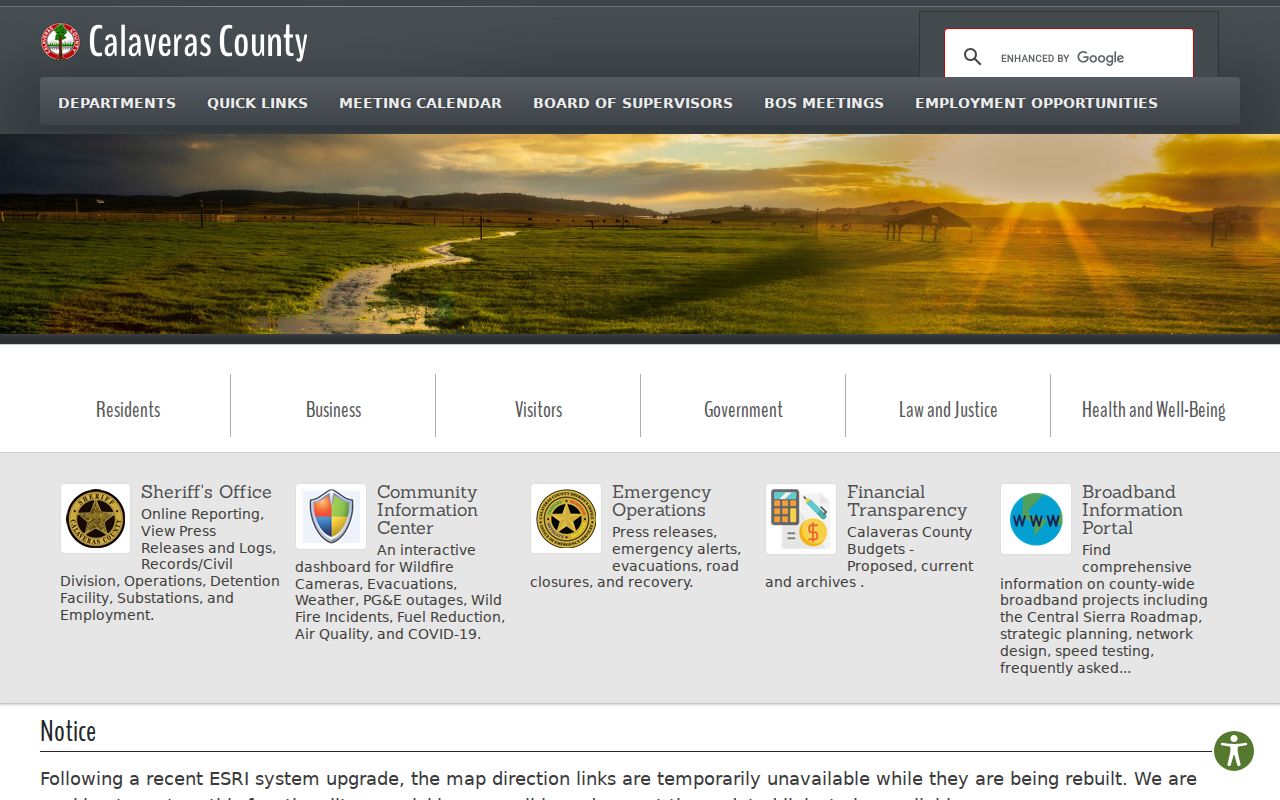
The office image supports the distinction between case representation and a public request for an Angels Camp police report.
Where Angels Camp Records End Up
A city incident can create several records as it moves. Police retain the investigative report. A custodial arrest creates a county booking file. The District Attorney decides whether to file charges, and the Superior Court records the case. Reportable fingerprints and dispositions can then feed California DOJ's summary criminal-history repository.
Record flow: Angels Camp Police › Calaveras County Jail and District Attorney › Calaveras Superior Court › California Department of Justice
That flow is not always instant. An arrest may appear before charges are filed. A disposition can take time to reach a state summary record. Sealed or confidential material may disappear from public view. For current facts, check the source office closest to the event, then move forward through the chain.
Angels Camp Cases and County Probation
A sentence to probation appears first in the court record. Calaveras County Probation then handles local supervision and uses a Public Safety Assessment in its SB 36 pretrial work. The probation office is at 23 E. Saint Charles in San Andreas, with mailing address 891 Mountain Ranch Road and phone (209) 754-6466. It is not a public name-search portal for Angels Camp.
The official Calaveras County Probation page supplies the department contact information.
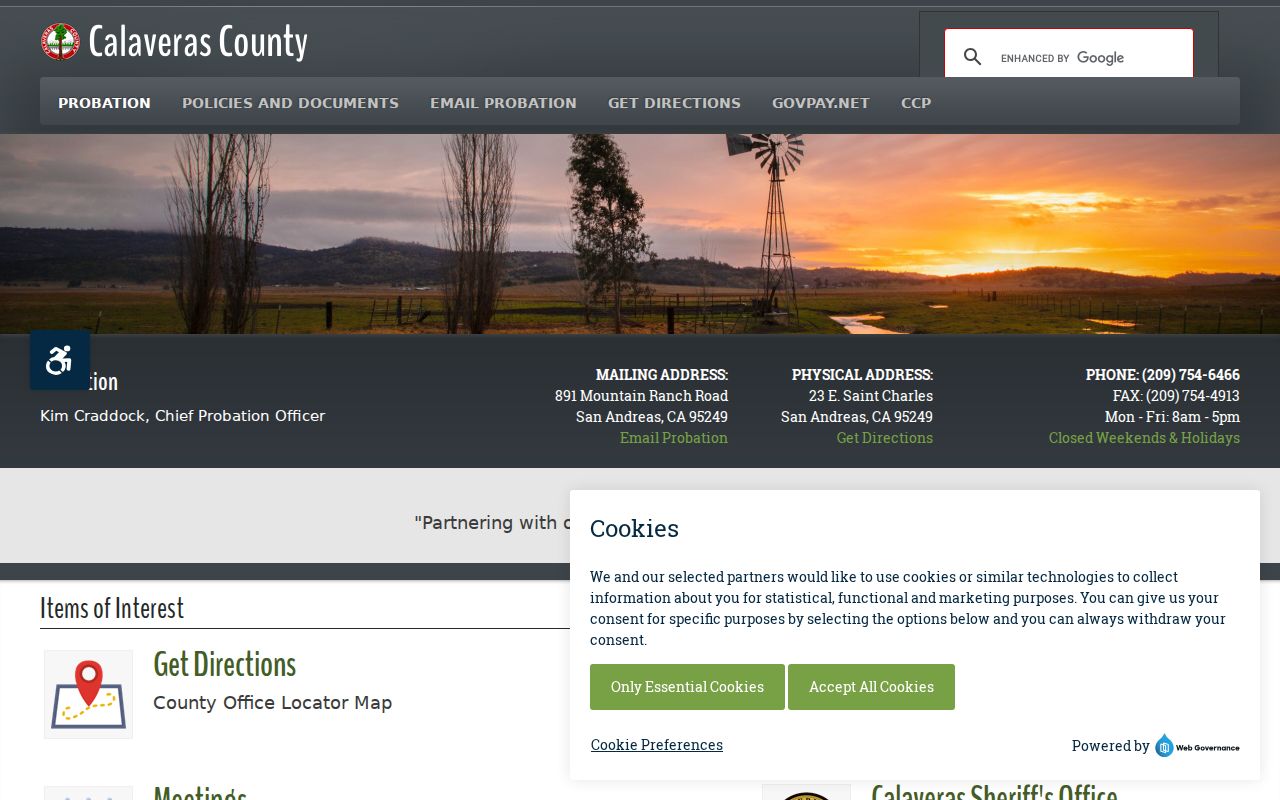
The county office demonstrates how an Angels Camp criminal case moves beyond the city once the court orders supervision.
The department's SB 36 Public Safety Assessment source documents the named pretrial tool.
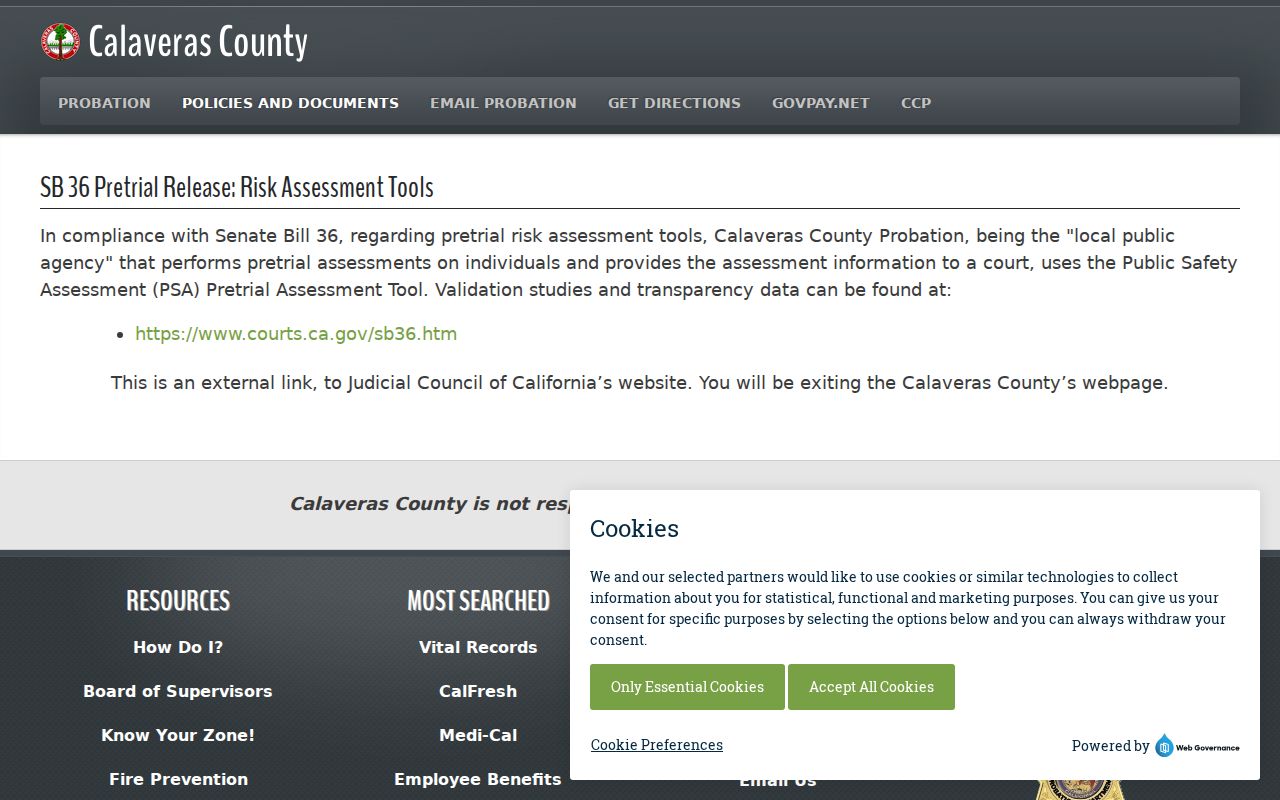
This source adds local context to pretrial processing without turning the assessment into a public criminal-record search.
Angels Camp Records After State Sentencing
A person sentenced to state custody moves beyond the Calaveras jail layer. The California Department of Corrections and Rehabilitation uses the California Incarcerated Records and Information Search, or CIRIS, for state-incarcerated population records. It is not the right tool for a fresh Angels Camp booking or a city police report.
The official CDCR CIRIS interface shows the state search channel.
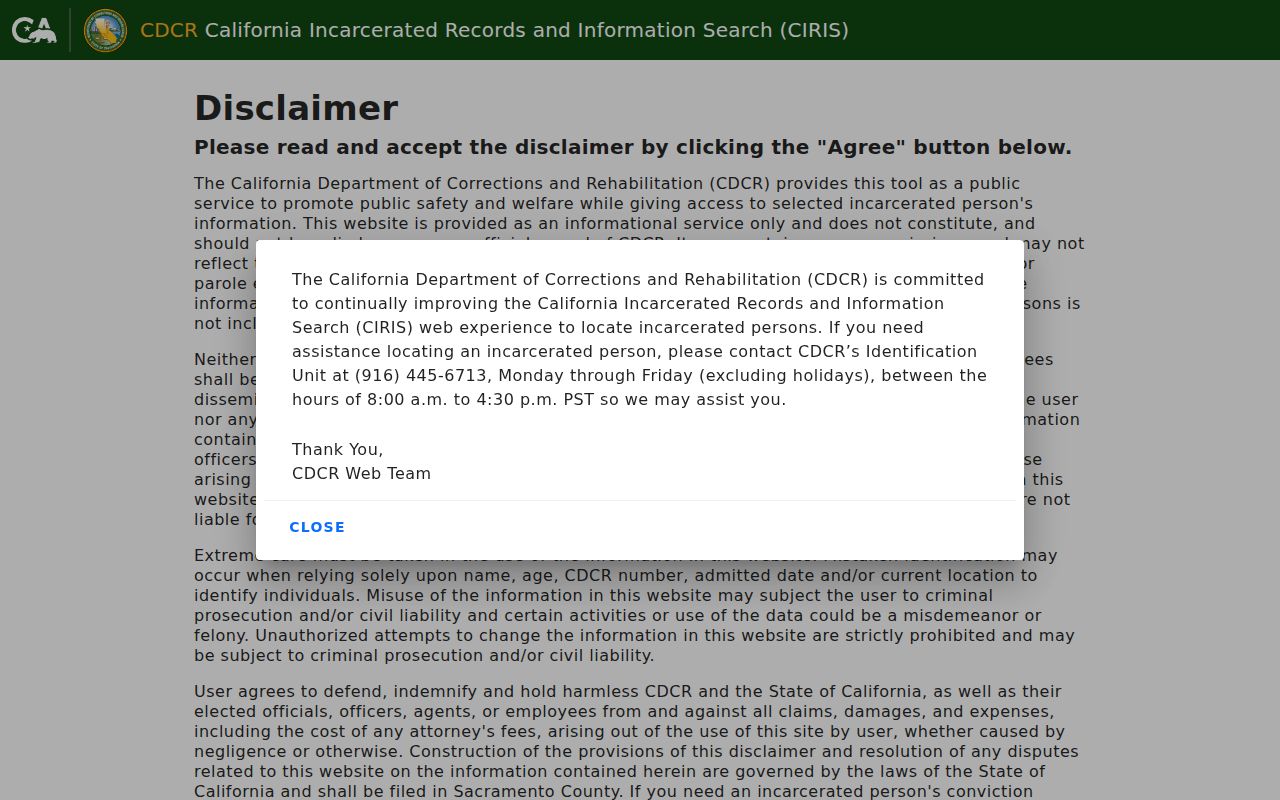
The image marks the last routing layer for qualifying state custody, well beyond the Angels Camp Police records counter.
Public Access Rules
City police records fall under the California Public Records Act, but the Act works alongside laws protecting investigations, juveniles, victims, and private data. State summary criminal history is more restricted: Penal Code section 11105 allows dissemination only to authorized recipients, while individuals may use DOJ's fingerprint process to review their own record. Court indexes are generally more open than remote criminal documents.
Key Statutes:
California Public Records Act requires access to city records unless an exemption applies.
Penal Code section 11105 restricts California DOJ summary criminal-history dissemination.
California Rule of Court 2.503 limits broad remote access to criminal court documents while preserving courthouse access.
For Angels Camp, the practical rule is simple: request the city-created report from city police, the booking from the sheriff, and the filed case from the Superior Court. Each custodian can release only what its law and record permit.